
Healing support
PRF (Platelet‑Rich Fibrin)
PRF is made from a small sample of your own blood and can be used during oral surgery to support healing in select cases.
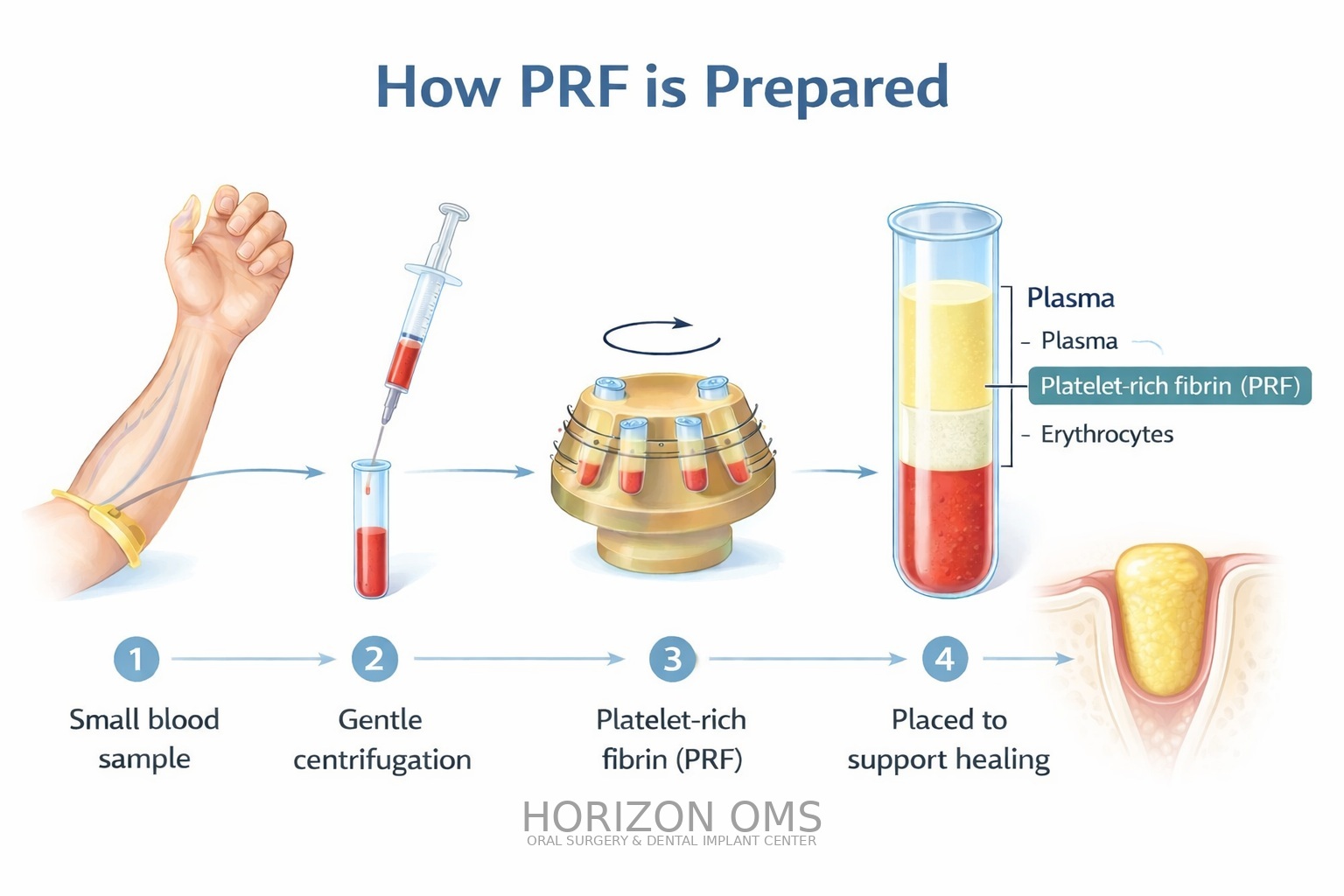
What is PRF?
PRF stands for Platelet‑Rich Fibrin. It’s a concentrated “healing matrix” created from a small sample of your own blood. PRF is rich in platelets, white blood cells, and growth factors, held together in a fibrin scaffold (think of it like a natural, sticky healing bandage).
Because PRF is made from your own blood (autologous), it’s biocompatible and does not involve synthetic additives during preparation in standard PRF protocols.
How is PRF obtained?
- Quick blood draw: We draw a small amount of blood—similar to routine lab work.
- Spun in a centrifuge: The blood is gently centrifuged for a short time to separate components.
- PRF is collected and shaped: The PRF can be prepared as a membrane (like a soft, flexible bandage), a plug, or an injectable form depending on the clinical goal.
- Placed where it’s needed: PRF is placed into an extraction socket and/or combined with graft material.
Why we use PRF
Potential benefits after extraction
- May reduce post‑op discomfort and pain medication use
- May reduce swelling in some cases
- May reduce risk of “dry socket” (alveolar osteitis) in some studies
- Supports soft tissue healing in the early healing window
Potential benefits with bone grafting
- Acts as a natural biologic “binder” that can help graft particles handle and stay together
- May support early bone healing and regeneration in extraction sites
- Evidence in guided bone regeneration continues to evolve and results vary
Important: PRF is not a guarantee of faster healing or a substitute for good surgical technique and aftercare. We’ll discuss whether PRF is appropriate for your specific situation.
PRF for wisdom teeth sockets
After wisdom tooth removal, we can place PRF into the socket(s). The goal is to support healing and reduce common post‑op issues like discomfort, swelling, and dry socket risk (depending on your individual risk factors and surgical complexity).
What you can expect
- PRF is placed at the end of the procedure (before sutures when needed).
- It gradually resorbs on its own—nothing needs to be removed.
- Your standard aftercare instructions still apply (diet, hygiene, activity, meds as indicated).
PRF mixed with bone grafts
In procedures like socket preservation, ridge preservation, or other bone grafting needs, PRF can be combined with bone graft particles. This can create a cohesive, easy‑to‑handle graft mixture and adds your body’s own growth‑factor rich matrix to the site. Evidence suggests PRF may enhance early healing in post‑extraction sites and may benefit some reconstructive/guided bone procedures, though results vary and ongoing research continues to refine best practices.
Tooth replacement planning after extraction
If a non‑wisdom tooth is removed, replacement is often discussed with your dentist and surgeon based on your goals and clinical needs. Replacement options may be fixed (dental implant vs bridge), removable (partial or complete denture), or sometimes none at all. Many cases also benefit from bone grafting and/or soft tissue procedures to optimize long‑term outcomes.
Research articles & patient resources
If you’d like to go deeper, here are reputable articles and reviews on PRF in oral surgery, extraction healing, dry socket, and bone regeneration:
- Choukroun et al. (2006) — Platelet‑rich fibrin (PRF): a second‑generation platelet concentrate
- Zwittnig et al. (2024) — Effectiveness of PRF in third molar (wisdom tooth) extractions
- Ye et al. (2024) — PRF after lower third molar extraction (pain, swelling, dry socket, trismus)
- Yang et al. (2024) — PRF after mandibular third molar extraction (systematic review)
- Al‑Maawi et al. (2021) — PRF in post‑extraction healing (review)
- Ucer et al. (2023) — PRF in alveolar ridge preservation (review)
- Arora et al. (2024) — PRF in guided bone regenerative procedures (systematic review & meta‑analysis)
- Laforgia et al. (2024) — PRF and dry socket management (review)
Questions about PRF?
We’ll explain your options—including whether PRF makes sense for your extraction, socket preservation, or bone grafting plan.
Phone: (630) 425-2555
Email: Contact@Horizon-OMS.com